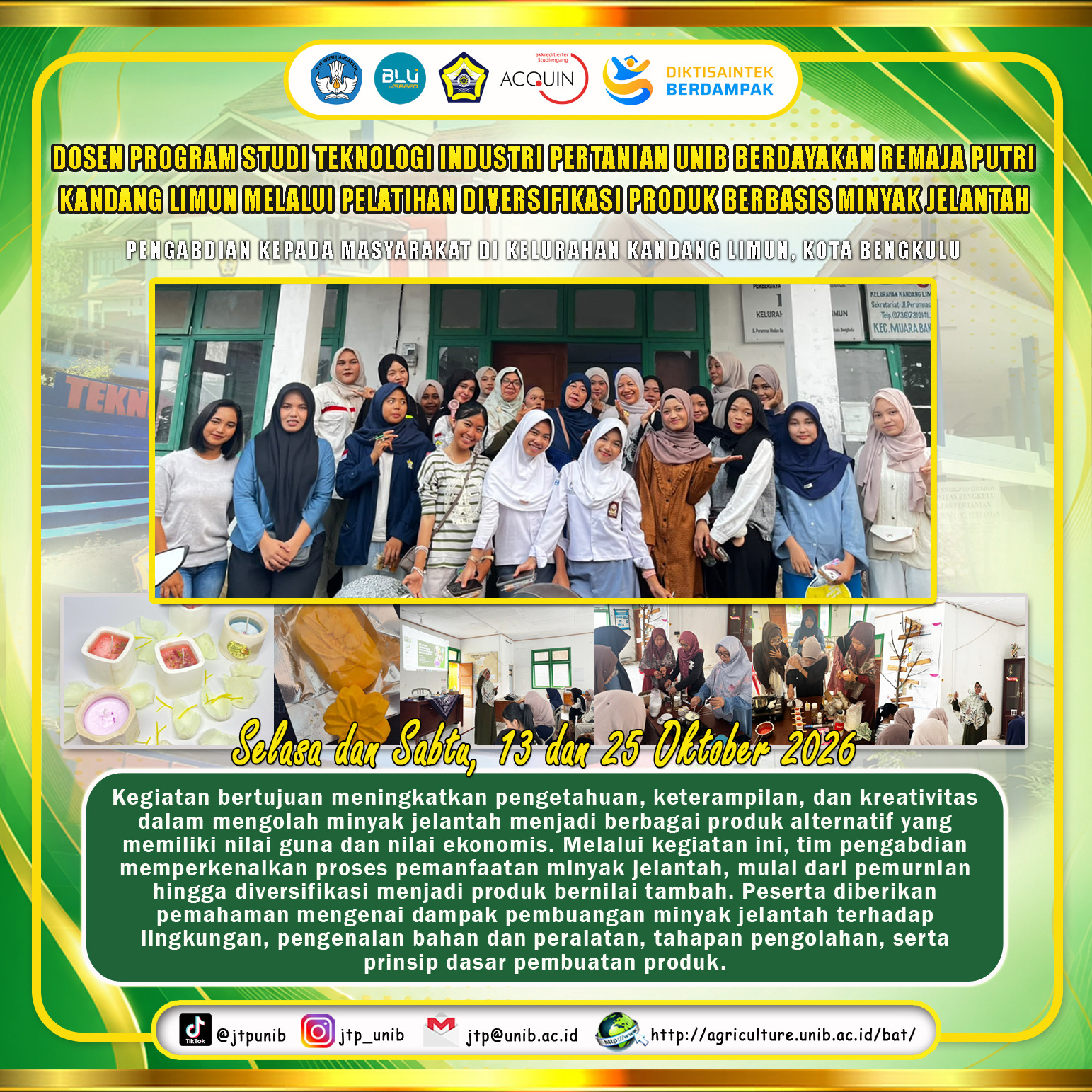
Lecturers of the UNIB Agricultural Industry Technology Study Program Empower Teenage Girls in Lemonade Cages through Training on Diversification
A team of lecturers from the Agricultural Industrial Technology Study Program (TIP), Department of Agricultural Technology, Faculty of Agriculture, University of Bengkulu consisting of Dra. Devi Silsia, M.Si., Selly Ratna Sari, S.Pi., M.Si., and Dr. Yessy Rosalina, S.T.P., M.Si. carried out a Community Service activity entitled “Empowerment of Adolescent Women through Training on the Diversification of Economically Valuable Products Based on Used Cooking Oil in Kandang Limun Village.” This activity was held on October 13 and 25, 2026 in Kandang Limun Village, Bengkulu City, with the target of adolescent girls.
This activity aims to increase the knowledge, skills, and creativity of young women in processing used cooking oil into various alternative products that have use and economic value. Used cooking oil is household waste that often has not been utilized optimally. Disposal directly into the environment has the potential to cause soil and water pollution. Therefore, educational efforts and the application of simple technology are needed so that the waste can be managed into more useful products.
Through this activity, the service team introduced the process of using used cooking oil, starting from purification to diversification into value-added products. Participants were given an understanding of the impact of used cooking oil disposal on the environment, introduction to materials and equipment, processing stages, and basic principles of product manufacturing. In addition to delivering materials, training was also carried out through hands-on practice so that participants could understand the processing process more easily and applicably.
The products developed in this training include solid soap, liquid soap, and used cooking oil-based aromatherapy candles. Participants were introduced to the necessary ingredients, manufacturing stages, and occupational safety aspects during the processing process. One of the practices that attracted the attention of participants was the manufacture of aromatherapy candles by utilizing used cooking oil and supporting ingredients such as stearin and fragrances. Through this practice, participants learned to produce alternative products with an attractive appearance and aroma and have the potential to be developed as a handicraft product with selling value.
The enthusiasm of the participants was seen during the training, especially when directly involved in the product manufacturing process. This activity provided a new experience for young women that used cooking oil, which has been considered as worthless waste, can be reused through the application of proper treatment technology. Thus, this training not only provides technical skills, but also fosters awareness about the importance of managing household waste more responsibly.
In addition to environmental aspects, this service activity is expected to encourage the creativity and entrepreneurial spirit of young women. The skills gained can be a provision to develop products independently, recognize business opportunities, and create simple products that have economic potential. The use of used cooking oil as a diversified product also opens up opportunities for the development of a creative economy based on resources and household waste available in the community.
This activity is a form of contribution of lecturers from the Agricultural Industrial Technology Study Program, Department of Agricultural Technology, Faculty of Agriculture, University of Bengkulu in applying science and technology to the community. Through the empowerment of young women in Kandang Limun Village, this activity is expected to encourage the formation of a creative, independent, environmentally friendly, and productive young generation. In the future, the development of activities through mentoring and product innovation is expected to expand the use of used cooking oil while creating economic opportunities for the community.


