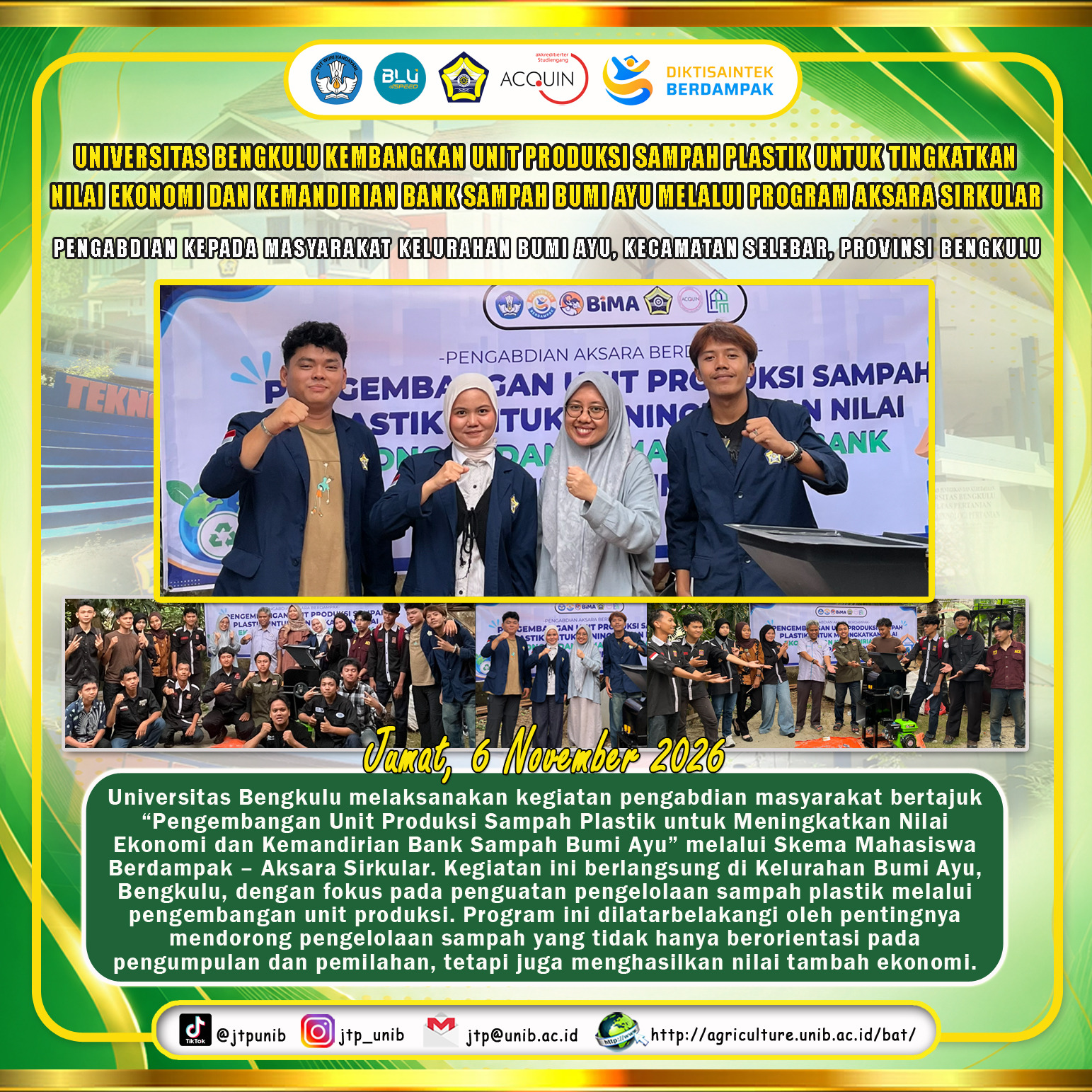
University of Bengkulu Develops Plastic Waste Production Unit to Increase Economic Value and Independence of Bumi Ayu Waste Bank through the Circular Script Program
The University of Bengkulu carried out a community service activity entitled “Development of Plastic Waste Production Units to Increase the Economic Value and Independence of the Bumi Ayu Waste Bank” through the Impact Student Scheme – Circular Script on Friday, November 6, 2026. This activity took place in Bumi Ayu Village, Selebar District, Bengkulu Province, with a focus on strengthening plastic waste management through the development of production units. This program is motivated by the importance of encouraging waste management that is not only oriented towards collection and sorting, but also able to generate economic added value. Through this approach, plastic waste that was previously considered waste is expected to be used as raw materials to produce products that have use value and selling value.
This service activity was carried out by a team of lecturers from the University of Bengkulu consisting of Ir. Agus Nuramal, S.T., M.T. and Dr. Ir. Zuliantoni, S.T., M.T. from the Faculty of Engineering, University of Bengkulu, and Ulfah Anis, S.T.P., M.Sc. from the Agricultural Industrial Technology Study Program, Department of Agricultural Technology, Faculty of Agriculture, University of Bengkulu. This cross-faculty collaboration combines scientific competencies in the field of engineering and industrial technology to support the development of plastic waste production units. This synergy is expected to contribute to the development of a more productive processing system, starting from the use of the potential of plastic waste raw materials to the development of production processes that can be applied and managed sustainably by the community.
The implementation of this program also involved 20 students from the University of Bengkulu from three study programs, namely 10 Mechanical Engineering students, 7 Industrial Engineering students, and 3 Agricultural Industrial Technology students. The involvement of students across disciplines is a form of implementation of experience-based learning through direct involvement in community empowerment activities. Students have the opportunity to apply knowledge and skills according to their scientific fields while understanding waste management issues in the community. Collaboration between lecturers, students, and the community is also a means to build synergy in developing solutions that are not only technical, but also consider aspects of productivity and sustainability of business management.
Through the Student Impact Scheme – Circular Letters, the development of this plastic waste production unit is expected to strengthen the capacity and independence of the Bumi Ayu Waste Bank in managing the potential of plastic waste into products with economic value. The existence of the production unit is expected to open up opportunities to increase income, expand the benefits of waste bank activities, and encourage the growth of productive economic activities based on waste utilization. In addition to providing economic benefits for the community, this program is also part of efforts to implement circular economy principles through waste reduction and reuse of materials that still have use value. Thus, this service activity is expected to have a sustainable impact on strengthening the community’s economy while supporting the creation of a cleaner and responsible environment for waste management.


