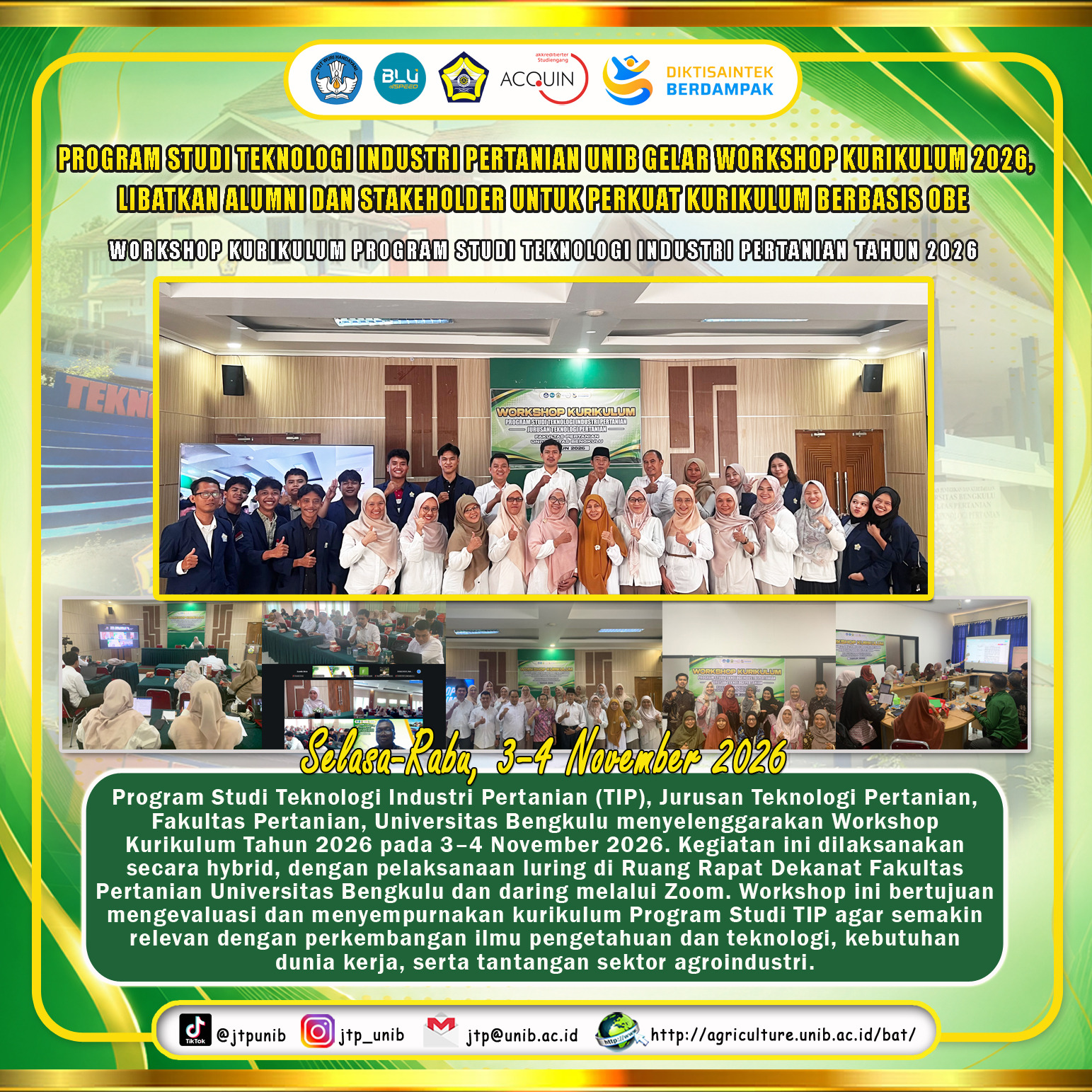
UNIB Agricultural Industry Technology Study Program Holds 2026 Curriculum Workshop, Involving Alumni and Stakeholders to Strengthen OBE-Based Curriculum
The Agricultural Industrial Technology Study Program (TIP), Department of Agricultural Technology, Faculty of Agriculture, University of Bengkulu, held the 2026 Curriculum Workshop on November 3–4, 2026. The activity was conducted in a hybrid format, with offline sessions at the Dean’s Meeting Room of the Faculty of Agriculture and online participation via Zoom. The workshop aimed to evaluate and improve the TIP Study Program curriculum to ensure its relevance to scientific and technological developments, workforce requirements, and challenges in the agro-industrial sector.
The first day, Tuesday (3/11), began with an opening ceremony attended by faculty and department leaders, lecturers, alumni, and other participants. The event featured remarks from the Committee Chair, Ir. Marniza, M.Si., followed by the Head of the Department of Agricultural Technology, Dr. Yessy Rosalina, S.T.P., M.Si., and the Dean of the Faculty of Agriculture, Prof. Dr. Ir. Suharyanto, S.Pt., M.Si., who officially opened the workshop. The main agenda included an alumni sharing session featuring five TIP graduates: Asima Rohana, S.T.P. (Kepahiang Regency Agriculture Office), Nugraha Wahyu Saputra, S.T.P. (PT Agri Wangi Berry), Jubles Asotakawan S., S.T.P. (BRI), Lukas Morasi Lumban Tobing, S.T.P. (PT STA Group), and Rozi Satria Utama, S.T.P., M.Si. (Payakumbuh State Agricultural Polytechnic). They shared insights into their career experiences, the application of academic competencies in professional settings, and the skills required to meet industry demands.
The workshop continued with a stakeholder sharing session involving representatives from business, industry, and government institutions, namely Purgiyanto from PT SMART Tbk., Maspiyono Haryono from PT Mayora Indah Tbk., Henny Yonalia from PT Indofood Fortuna Makmur, and Ahmad Taufik, S.T.P., M.P. from the Agricultural Human Resources Extension and Development Agency (BPPSDMP), Ministry of Agriculture of the Republic of Indonesia. The afternoon sessions featured material from Prof. Dr. Yuli Wibowo, S.T.P., M.Si., representing the Agroindustry Technology Professional Association (APTA), entitled “Development of the OBE-Based TIP Study Program Curriculum: Alignment of Graduate Learning Outcomes, Workforce Needs, and Academic Quality Enhancement.” This was followed by training on developing Outcome-Based Education (OBE) Semester Learning Plans (RPS) integrating TPACK and STEAM in Agricultural Industrial Technology education, delivered by Prof. Dr. Arono, M.Pd. from LPMPP. The discussions and presentations provided valuable input for aligning graduate competencies with industry expectations and technological developments.
The second day, Wednesday (4/11), took place offline at the Meeting Room of the Department of Agricultural Technology, University of Bengkulu, focusing on curriculum evaluation and development based on Outcome-Based Education (OBE). The morning session involved TIP lecturers reviewing and refining the curriculum design based on feedback from alumni, stakeholders, and the previous day’s presentations. Discussions covered the formulation of graduate profiles and Graduate Learning Outcomes (CPL), ensuring alignment between expected competencies, graduate user requirements, study materials, and courses. In the afternoon, participants were divided into three working groups representing the study program’s scientific pillars: Management, Technology and Environment, and Systems Engineering. Each group examined required competencies, supporting study materials, areas requiring further emphasis, potential overlaps, and competencies not yet accommodated in the existing curriculum before preparing recommendations for curriculum improvement.
Through the 2026 TIP Curriculum Workshop, the study program expects to develop a more adaptive, integrated, and graduate-oriented curriculum in accordance with the OBE approach. The involvement of alumni, industry representatives, government institutions, and professional associations provided essential perspectives to strengthen the relevance of the curriculum to workforce needs and developments in the agro-industrial sector. This initiative reflects the commitment of the Agricultural Industrial Technology Study Program, Department of Agricultural Technology, Faculty of Agriculture, University of Bengkulu, to continuously improve educational quality and produce competent, professional graduates capable of adapting to scientific and technological advancements and the evolving needs of society.


