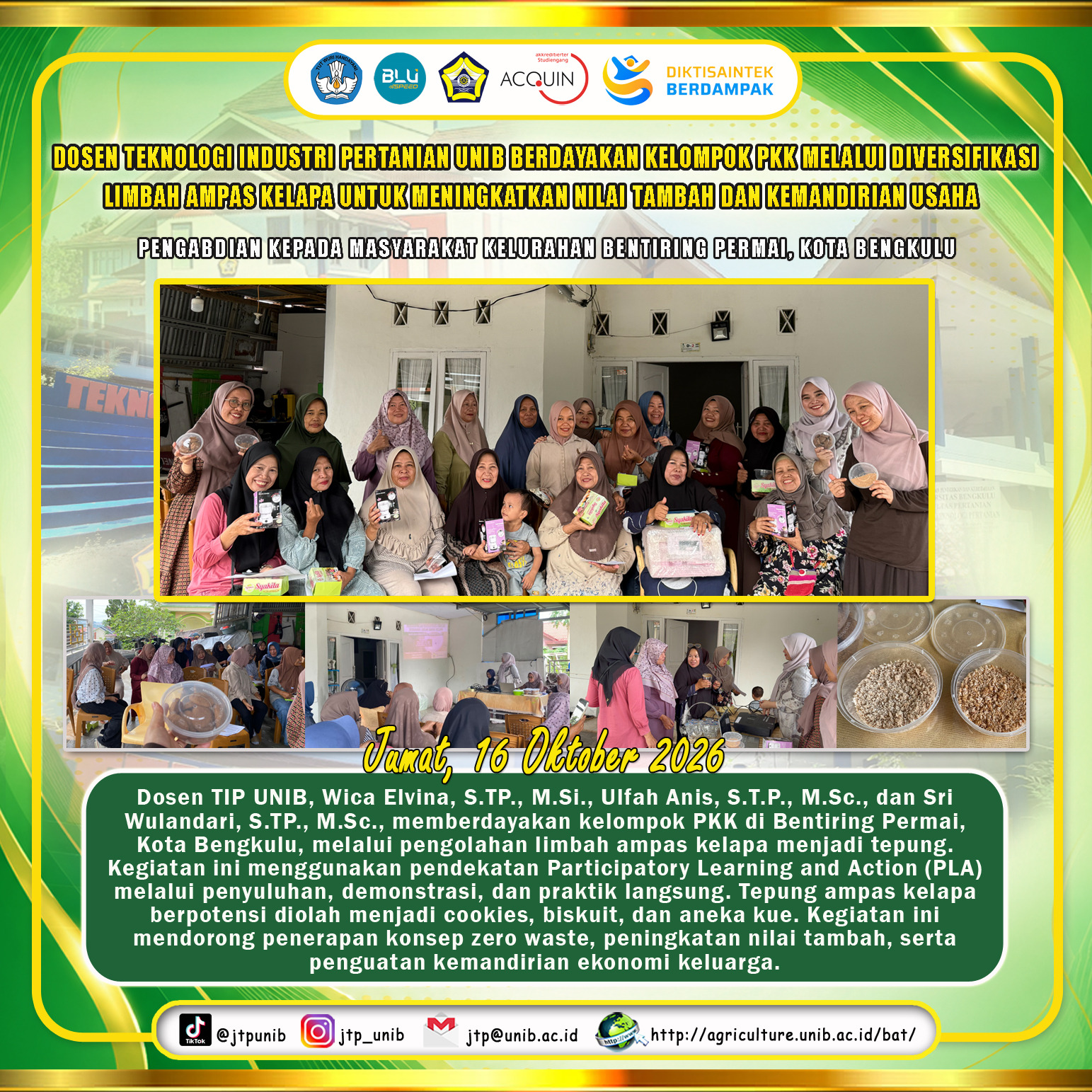
UNIB Agricultural Industry Technology Lecturer Empowers PKK Group through Diversification of Coconut Pulp Waste to Increase Added Value and Business Independence
Lecturers of the Agricultural Industrial Technology Study Program (TIP), Department of Agricultural Technology, Faculty of Agriculture, University of Bengkulu carried out activities to empower the PKK group through diversifying coconut pulp waste into flour as an effort to increase added value and independence of household businesses. The activity, which was held on October 16, 2026, took place at RT 22 RW 03 Azzahra Housing, Bentiring Permai Village, Bengkulu City, by involving PKK group members as participants. This activity was motivated by the potential of coconut pulp as a by-product of processing coconut milk which still contains dietary fiber, but has not been optimally utilized at the household level.
This activity was carried out by a team of lecturers from the Agricultural Industrial Technology Study Program, namely Wica Elvina, S.TP., M.Si., Ulfah Anis, S.T.P., M.Sc., and Sri Wulandari, S.TP., M.Sc. by applying the Participatory Learning and Action (PLA) approach. This approach places participants as active subjects through counseling activities, demonstrations, direct practice, as well as monitoring and evaluation. Participants were given knowledge about the potential use of coconut pulp as a food raw material, then trained to process it into flour through several stages, starting from cleaning, drying using an oven at a temperature of 80–100°C for 60 minutes, smoothing using a grinder or blender, to sifting to produce finer flour.
Through this activity, participants gained basic skills in producing coconut pulp flour which has the potential to be developed into various value-added food products, such as cookies, biscuits, cakes, and various wet cakes. In addition to processing practices, participants were also introduced to aspects of food packaging and opportunities for local resource-based business development. The results of the activity showed an increase in participants’ knowledge about the potential of coconut pulp as a food raw material, the ability to practice the stages of making flour, and the growing interest in developing food products as a household business opportunity.
This empowerment activity is expected to encourage the community to make more optimal use of household waste through the application of the zero waste concept, while increasing the use value of coconut by-products and strengthening family economic independence. As a follow-up, continuous assistance is needed in improving the processing process, quality testing and consumer acceptance, as well as developing business aspects that include packaging, production cost calculation, selling price determination, and marketing strategy. Thus, coconut pulp flour is not only an alternative to food raw materials, but also has the potential to be developed into a superior product for household businesses.


