University of Bengkulu Team Educates Sambirejo Community on Turning Household Waste into Local Microorganisms
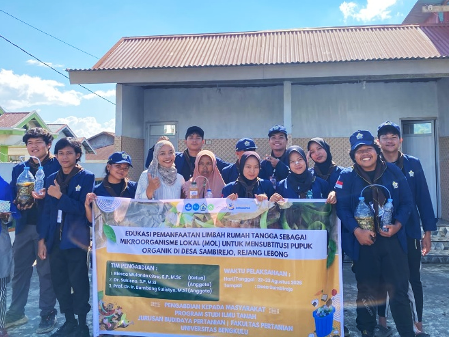
Rejang Lebong, August 22–23, 2026 — A Community Service Team from the Faculty of Agriculture, University of Bengkulu, conducted an educational program on utilizing household organic waste to produce Local Microorganisms (Mikroorganisme Lokal, or MOL) in Sambirejo Village, Rejang Lebong Regency, Bengkulu Province, Indonesia. Entitled “Education on the Utilization of Household Waste as Local Microorganisms (MOL) to Substitute Organic Fertilizers in Sambirejo Village, Rejang Lebong,” the program introduced the community to practical ways of reusing organic household waste to support agricultural activities.
The program was led by Riesca Wulanda Citra, S.P., M.Sc., with team members Dr. Sukisno, S.P., M.Si., and Prof. Dr. Ir. Bambang Sulistyo, M.Si., and involved students from the Soil Science Study Program, Faculty of Agriculture, University of Bengkulu. Approximately 25 participants attended the activity, consisting of 15 farmer group members, eight members of the Family Welfare Movement (PKK), and two village officials. The participation of these community groups was expected to broaden awareness of household organic waste management and its potential application in agriculture.
Household organic waste, including vegetable scraps, fruit waste, and leftover rice, is often discarded after use. However, these materials have the potential to be reused through appropriate processing. One alternative introduced during the program was the production of Local Microorganisms (MOL), a fermented solution made from organic materials that may serve as a supporting component in agricultural organic matter management.
Through this program, community members were introduced to simple ways of processing organic waste using materials readily available in their surroundings. This approach was expected to encourage the reuse of household waste while introducing practical techniques relevant to the needs of the local farming community.
The team leader, Riesca Wulanda Citra, S.P., M.Sc., explained that the program was designed to provide participants not only with theoretical knowledge but also with hands-on experience in producing MOL.
“Through education and hands-on practice, we aim to show the community that household organic waste still has potential value. With appropriate knowledge and processing methods, materials that would otherwise be discarded can be transformed into useful resources,” she explained.
The program began with an educational session introducing MOL, the types of organic materials suitable for its production, and its potential role in agricultural organic matter management. Participants learned about readily available materials, including vegetable scraps, fruit waste, and leftover rice. This introductory session prepared them for the subsequent demonstration and practical training.
Following the educational session, the program continued with a demonstration and hands-on MOL production. The team and participants prepared three types of MOL using vegetables, fruit, and rice as the respective organic materials. Participants took part in the preparation and mixing of the materials and placed the mixtures into fermentation containers.
The team also introduced fermentation bottles equipped with tubing as part of the practical demonstration. Through this activity, participants could directly observe the preparation process and the handling of containers used during fermentation. The hands-on approach was intended to help participants understand the production stages more clearly.
The practical session produced three bottles labeled vegetable MOL, fruit MOL, and rice MOL. These products still require further fermentation until they reach maturity. Therefore, the bottles represent the products of the practical demonstration that will continue through the fermentation process, rather than finished products that have already been confirmed ready for use.
In addition to the practical session, the team provided leaflets containing instructions for producing MOL from household organic waste. These leaflets served as supplementary educational materials that participants could refer to after the program. They are expected to help participants review the production steps and serve as a reference if they wish to practice MOL production independently.
Through the educational sessions and hands-on practice, the program provided participants with an opportunity to learn about organic waste utilization through direct experience. The involvement of farmer group members and PKK members was also expected to help disseminate information about household organic waste management within their respective communities.
The sustainability of the program may be supported through monitoring the fermentation process, introducing the characteristics of mature fermentation products, and providing further education on appropriate MOL application. These follow-up steps are important to ensure that the products are properly handled before being used in agricultural activities. MOL application should also be adjusted to agricultural needs and should not automatically be considered a complete substitute for all crop fertilizer requirements.
This community service activity forms part of the implementation of the Tri Dharma of Higher Education by the Faculty of Agriculture, University of Bengkulu. Through collaboration among university lecturers, students, farmer groups, PKK members, and village officials, the program is expected to serve as an initial step toward more productive household organic waste management and the promotion of sustainable agricultural practices.


