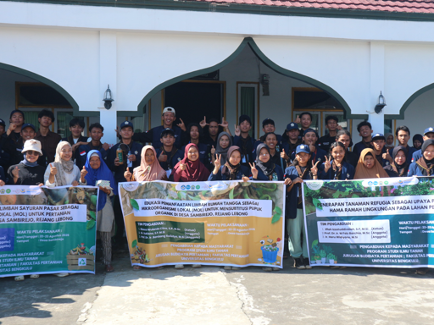
Implementation of Refugia Plants as an Eco-Friendly Pest Control Approach on Agricultural Land in Sambirejo Village
Rejang Lebong, October 2026 — A community service team from the Soil Science Study Program, Faculty of Agriculture, Universitas Bengkulu, led by Iffah Izzatuddinillah, S.P., M.Si., alongside team members Prof. Dr. Ir. M. Faiz Barchia, M.Sc. and Ir. Heru Widiyono, M.Si., with the support of student team members Alfedo Fahrezi, Zaskia Afriza Khairunisa, and Aditya Pasya, conducted a community service initiative titled “Implementation of Refugia Plants as an Eco-Friendly Pest Control Approach on Agricultural Land in Sambirejo Village, Selupu Rejang District, Rejang Lebong Regency.”
This initiative was carried out as part of Universitas Bengkulu’s commitment to supporting sustainable agriculture systems and reducing farmers’ reliance on chemical pesticides. Through this program, local residents and farming groups were encouraged to adopt ecologically-based Integrated Pest Management (IPM) practices by utilizing refugia plants.
The primary focus of this activity was to enhance farmers’ knowledge and skills in managing habitats for natural pest enemies (predators and parasitoids). According to the team leader, Iffah Izzatuddinillah, S.P., M.Si., implementing refugia plants is a strategic step toward maintaining the natural balance of the agricultural ecosystem.
“Continuous and excessive use of chemical pesticides can degrade environmental quality, trigger pest resistance, and eradicate natural predators. By utilizing refugia plants, we not only suppress crop pest populations naturally but also support the creation of a healthier, more productive, and sustainable agricultural ecosystem,” she stated.
The series of activities began with socialization and educational sessions covering the basic concepts of refugia plants, identifying flowering plant species that effectively attract beneficial insects—such as cosmos (Cosmos caudatus), sunflowers (Helianthus annuus), marigolds (Tagetes erecta), and zinnias (Zinnia elegans)—and learning proper planting techniques around crop cultivation areas. The session continued with an interactive discussion involving local residents and farming groups to identify the primary pest issues frequently encountered on horticultural land in Sambirejo Village.
Furthermore, the service team, alongside participants and student members (Alfedo Fahrezi, Zaskia Afriza Khairunisa, and Aditya Pasya), conducted field demonstrations. During these practical sessions, the team distributed educational media such as leaflets and brochures while guiding the community on effective refugia layout and planting methods. The participatory approach allowed the community to engage actively at every stage, fostering a sense of ownership and commitment to ensuring the program’s long-term sustainability.
Evaluation results demonstrated a highly positive response and a significant increase in community understanding regarding the critical role of refugia in maintaining agroecosystem balance. This community service program is expected to serve as an initial step toward establishing Sambirejo Village as a pilot project for eco-friendly agriculture in Rejang Lebong Regency. Additionally, this initiative contributes to the achievement of the Sustainable Development Goals (SDGs), particularly Goal 2 (Zero Hunger), Goal 12 (Responsible Consumption and Production), and Goal 15 (Life on Land).
“The success of eco-friendly agriculture requires synergy and continuous commitment. We hope that this refugia plant implementation model can be replicated by farmer groups in other areas, thereby delivering broader ecological and economic benefits for farmers across Bengkulu Province,” concluded Iffah Izzatuddinillah, S.P., M.Si.
This initiative was successfully carried out with the support of the Faculty of Agriculture at Universitas Bengkulu, the Sambirejo Village Government, HIMITA UNIB students, and the active participation of local farming groups and community members. The synergy between academics, students, village administration, and the local community is expected to build a strong foundation toward an independent and environmentally conscious agricultural system.


