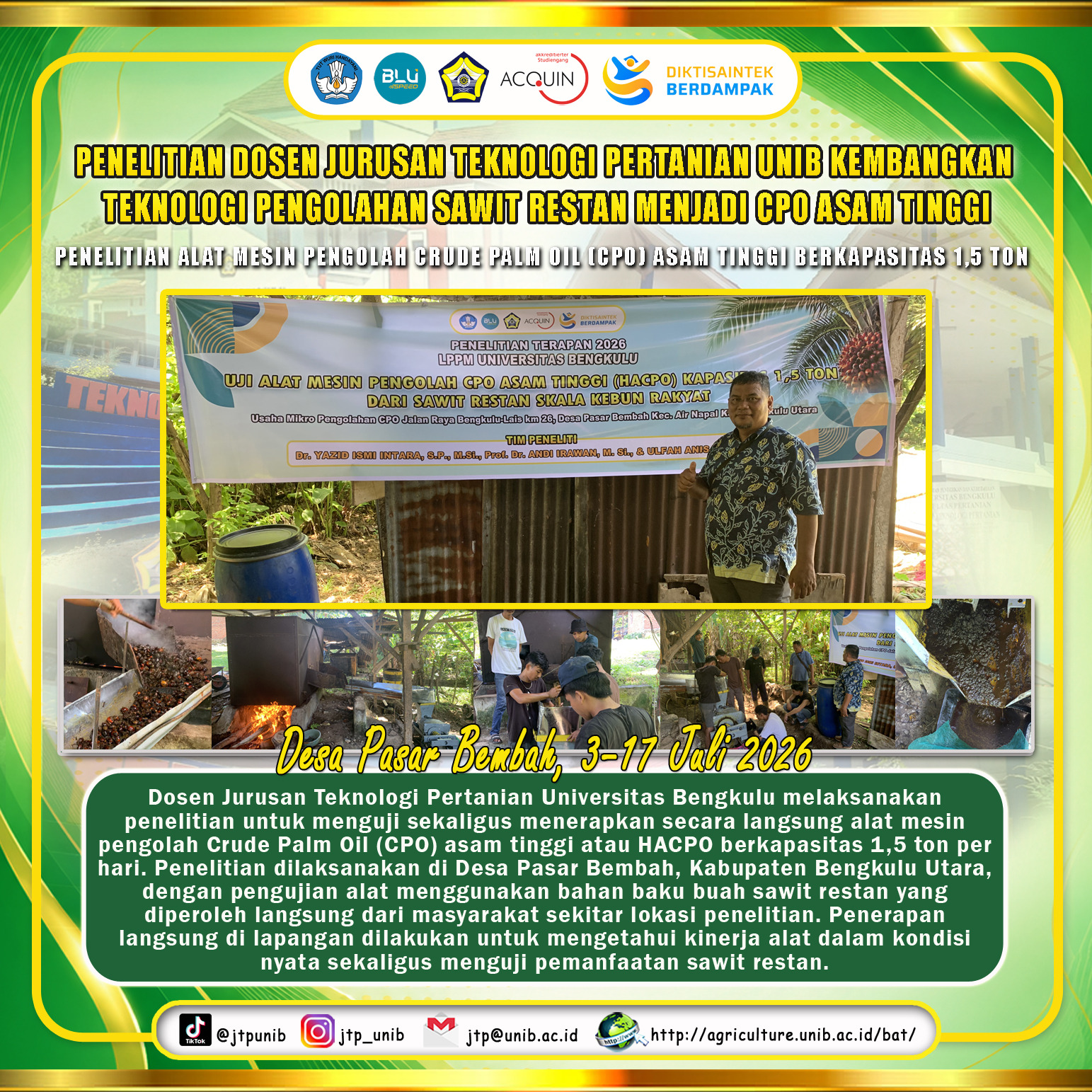
Research by Lecturers of the Department of Agricultural Technology UNIB Develop Restan Palm Oil Processing Technology into High Acid CPO
Lecturers of the Department of Agricultural Technology, University of Bengkulu (UNIB) conducted a research to test and directly apply High Acid CPO (HACPO) processing machine tools with a capacity of 1.5 tons per day. The research, which took place on July 3-17, 2026, was carried out in Pasar Bembah Village, Air Napal District, North Bengkulu Regency, by testing tools using raw materials for restan palm fruit obtained directly from the community around the research site. Direct application in the field was carried out to determine the performance of the tool in real conditions as well as test the use of restan palm oil as a raw material for HACPO processing in the development of agroindustrial technology based on community gardens.
The research was chaired by Dr. Yazid Ismi Intara, S.P., M.Si., a lecturer in the Department of Agricultural Technology, together with Prof. Dr. Andi Irawan, M.Si. and Ulfah Anis, S.T.P., M.Sc., a lecturer in the Department of Agricultural Technology. The development of a miniplant with a capacity of 1.5 tons per day is directed as an initiation of a palm oil agroindustry based on the people’s industry that can support the independence of smallholder oil palm farmers in Bengkulu Province. Through this approach, residual oil palm fruits that have the potential to become waste can be used as raw materials to produce value-added products.
Testing of the tool is carried out by directly applying the entire series of processing processes using raw materials from the surrounding community’s gardens. The fruit of the baldolan or restan palm is first put into the steaming unit for about an hour. After that, the material is flowed by gravity to the hopper of the screw press machine for the pressing process. The screw press machine operates at a rotary speed of around 9–13 rpm, with an electrical energy consumption of 19–21 kWh and a pressing pressure in the range of 50–60 bar. This direct application in the field is carried out to test the performance of the machine as well as to see the suitability of technology with the condition of raw materials available in people’s plantations.
From the processing process using a machine with a capacity of 1.5 tons per day, several products are produced in the form of HACPO, solids, shelled kernels, and fibers. By-products in the form of fiber are reused as fuel for the combustion process in the steaming unit. The reuse of these by-products is part of the processing concept that leads to efficient use of resources and waste reduction in the palm oil agro-industry system.
The development and direct testing of this technology is expected to be the first step in building a smallholder oil palm agroindustry model in Bengkulu Province. The use of restan palm into HACPO not only provides an alternative to processing plantation products at the community level, but also opens up opportunities to increase added value through the application of technology adapted to local conditions. In the future, the results of this test are expected to be the basis for the development of palm oil processing technology on a scale that is more independent, efficient, and sustainable.


