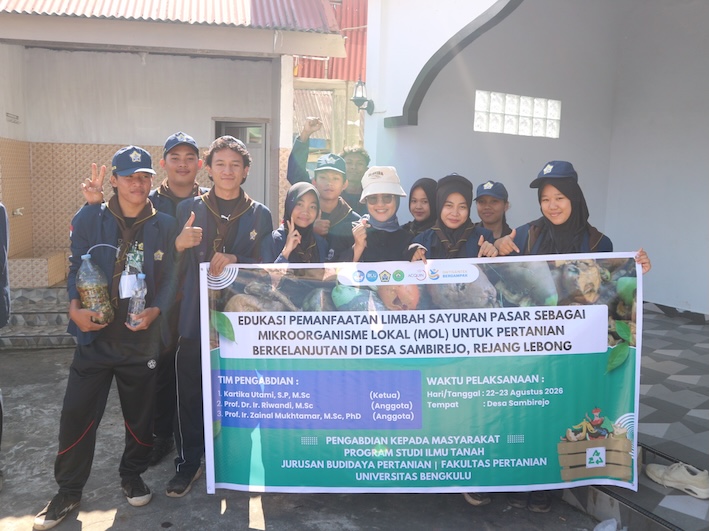
EDUCATION ON THE UTILIZATION OF MARKET VEGETABLE WASTE AS LOCAL MICROORGANISMS (MOL) FOR SUSTAINABLE AGRICULTURE IN SAMBIREJO VILLAGE, REJANG LEBONG
A. Implementation of the Activity
The community service activity entitled “Education on the Utilization of Market Vegetable Waste as Local Microorganisms (MOL) for Sustainable Agriculture in Sambirejo Village, Rejang Lebong” was held on 22–23 August 2026 in Sambirejo Village, Selupu Rejang District, Rejang Lebong Regency. The activity was part of the Faculty Community Service Scheme (PPM-F) and was carried out by a team from the Soil Science Study Program, Department of Agricultural Cultivation, Faculty of Agriculture, University of Bengkulu. The team consisted of Kartika Utami, S.P., M.Sc. as the leader, with Prof. Dr. Ir. Riwandi, M.Si. and Prof. Ir. Zainal Muktamar, M.Sc., Ph.D. as members. Students were involved in assisting the participants.
The activity used a community outreach method that included counseling, demonstrations, and hands-on practice in making MOL from market vegetable waste. The series of activities was designed to address the partners’ problems: heavy use of synthetic chemical fertilizers, limited use of local organic materials, and the accumulation of market vegetable waste that may pollute the environment.
B. Outreach and Preparation
The first stage of the activity was a presentation on the concept of MOL, its benefits as a decomposer and biofertilizer, and the role of market vegetable waste as a source of organic matter and natural microorganisms. This material helped participants understand that waste that is usually discarded can be turned into a valuable agricultural input.
Before the practice session began, the service team and students briefed the participants and arranged them at the venue. This allowed the demonstration to run smoothly and let every participant follow the MOL-making process up close.
C. MOL-Making Demonstration and Practice
The demonstration began with preparing the main material, market vegetable waste. The waste was sorted and chopped into small pieces so that fermentation would proceed more evenly, then placed into used plastic bottles. Used containers were chosen so that farmers could easily replicate the technology on their own at low cost.
The next stage was mixing the supporting ingredients and sealing the container. Each fermentation container was fitted with a hose to release the gas produced during fermentation, so the process could take place in a closed condition without the container swelling. Participants observed and practiced this stage directly, guided by the service team and students.
The fermentation produced a dark brown liquid. The team showed participants a sample of fully fermented MOL as an example of the final product, and explained how to store it and apply it to plants.
The activity showed that market vegetable waste can be used as a raw material for MOL with simple technology, readily available materials, and low cost. This is consistent with Indriani (2011), who stated that MOL contains various beneficial microorganisms, such as decomposing bacteria, phosphate-solubilizing bacteria, and nitrogen-fixing bacteria, which help improve soil fertility. Hadisuwito (2012) also reported that applying MOL can speed up composting and improve plant growth.
Presenting the material together with demonstrations and hands-on practice was chosen because farmers generally find it easier to understand a technology through real examples. This agrees with Mardikanto (2014), who emphasized that extension and mentoring are important factors in improving community knowledge, attitudes, and skills toward agricultural innovation. Documentation of the activity shows that participants were actively involved at every stage, from chopping the materials and filling the containers to observing the fermentation results.
From an environmental perspective, processing vegetable waste into MOL reduces the pile-up of organic waste that is otherwise discarded without management. From an economic perspective, farmers have an opportunity to cut the cost of buying chemical fertilizers, because the raw materials for MOL come from easily obtained waste. Continued use of MOL is also expected to improve soil properties, as reported by Sutanto (2015) and Isroi et al. (2009), through increased soil organic matter and microbial activity.
Sustainability of the program is directed through mentoring in the application of MOL on farmers’ fields, as well as monitoring and evaluation of the results. With the skills they have gained, farmers are expected to produce MOL independently and serve as an example for other farmers in applying sustainable agriculture based on local resources in Sambirejo Village.


